
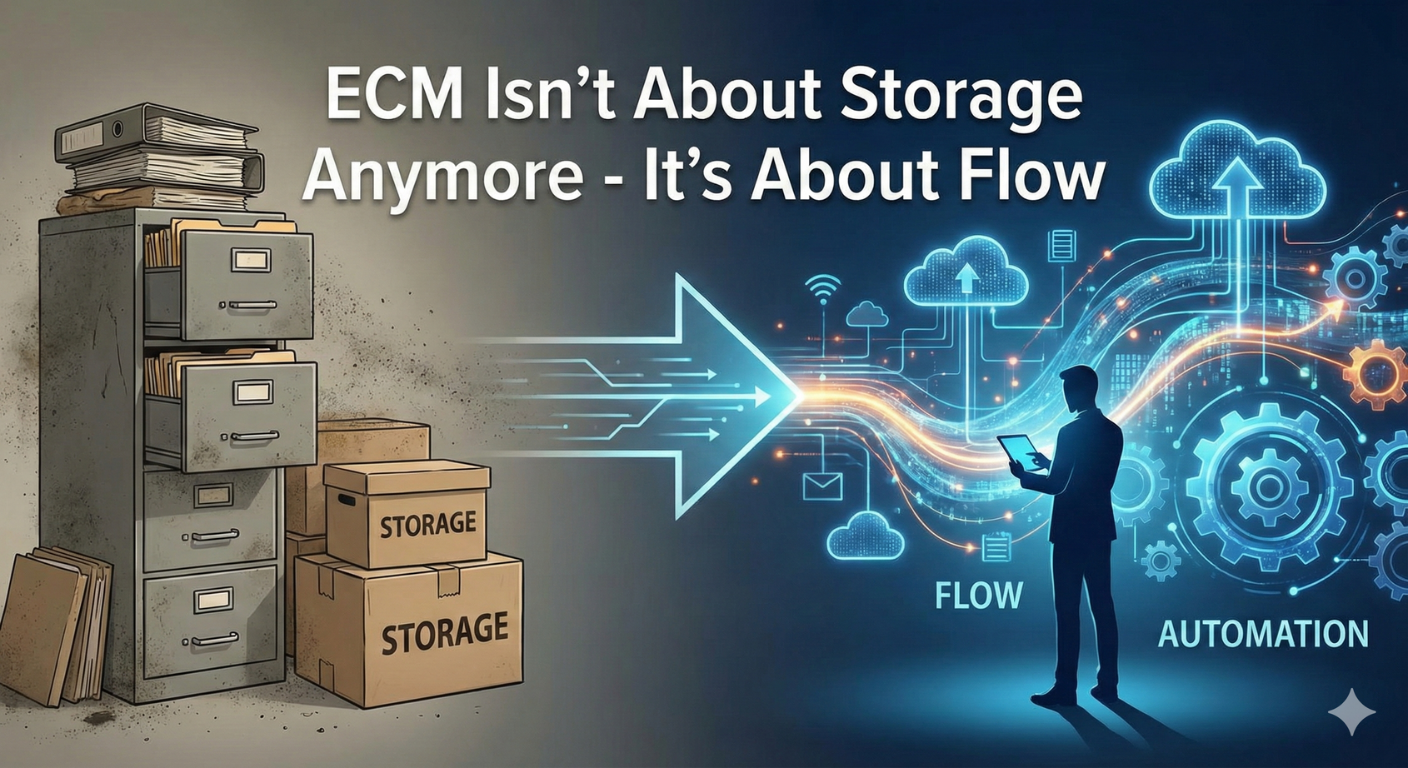
For years, businesses have treated ECM (Enterprise Content Management) as a storage problem:
- “Where do we put the files?”
- “Which folder should this document go in?”
- “Who has access to this?”
- “Why are there five versions of the same file?”
But as we move into 2026, the companies that thrive will be the ones that finally understand:
ECM is no longer about storing content.
It’s about how content moves.
Storage is passive.
Flow is active.
Storage reduces clutter.
Flow reduces friction.
And in a world where operations need to move faster — and teams are distributed, hybrid, or part-time — content flow becomes a strategic asset, not an IT problem.
1. The Problem With the Old ECM Mindset
Traditional ECM thinking treats content as something to:
- organize
- label
- archive
- search
Nothing wrong with that — but it’s not enough.
Storage-first ECM causes:
- multiple versions of documents
- unclear ownership
- hidden dependencies
- inconsistent templates
- outdated files resurfacing
- content stuck in personal drives
- emails replacing workflows
- slow approvals
- compliance gaps
The business doesn’t break visibly.
It just slows down quietly.
And by 2026, slow is the new broken.
2. Content Flow: The Real Definition of Modern ECM
Content flow means:
- documents move through steps
- every step has an owner
- content updates happen in predictable ways
- nothing gets stuck in someone’s inbox
- approvals follow a sequence
- information becomes accessible where work happens
- content supports the workflow
This is ECM redefined.
Content isn’t static.
It’s kinetic.
Companies don’t need more storage — they need more movement.
3. The Four Questions That Reveal ECM Weaknesses
Ask any team these four questions:
Q1: “Where is the latest version of that document?”
If the answer is:
- “Which one?”
- “Let me check…”
- “I think it’s in Teams/SharePoint/email…”
→ You have a flow problem.
Q2: “Who owns updating this?”
If ownership is unclear, the workflow is already failing.
Q3: “How does this document move to the next step?”
If the answer is “We send it manually,” you have a friction point.
Q4: “Where do we see the full history of edits, comments, and decisions?”
If the answer is “Across 10 emails,” the business is paying a hidden tax.
These questions expose content chaos immediately.
4. The 2026 ECM Model: Architecture for Movement, Not Storage
The modern ECM system has seven pillars:
Pillar 1: Single Source of Truth (SSOT)
One place where:
- the latest file lives
- version control is enforced
- ownership is clear
Not 20 folders in 5 team drives.
Pillar 2: Document Lifecycle Design
Every category of content needs:
- creation rules
- review steps
- approval requirements
- publishing guidelines
- archival conditions
The lifecycle is the real product.
Pillar 3: Metadata, Not Folders
Folders are human interpretations.
Metadata is structure.
Strong metadata:
- reduces search time
- improves retrieval
- supports workflow automation
- eliminates duplication
- improves compliance
- aligns cross-team use
Most SMBs don’t use metadata at all — it’s the biggest missed opportunity.
Pillar 4: Templates and Standardization
High-performing teams use:
- standard templates
- standard naming conventions
- standard review cycles
Consistency accelerates flow.
Pillar 5: Permissions That Follow Workflow, Not Org Chart
Most companies give access based on:
- department
- hierarchy
But content flow needs:
- role-based access
- stage-based access
- scenario-based access
Permissions aligned to flow reduce risk and increase speed.
Pillar 6: Content Governance
Governance doesn’t mean bureaucracy.
It means predictability.
Good governance:
- defines rules
- clarifies responsibilities
- prevents chaos
- ensures quality
- reduces risk
- enables faster execution
Most SMBs lack even a light governance model.
Pillar 7: Integrations With Work Systems
Content must sit inside:
- CRM
- project tools
- ticket systems
- collaboration platforms
- approval workflows
People shouldn’t need to “find” content.
Content should find them.
5. What Content Flow Looks Like in Practice (Real Scenarios)
Scenario 1: A contract moves from sales → legal → finance → client
Old way:
Email attachments → delays → missing comments → version chaos.
Flow-based way:
- One document
- Shared space
- Version history
- Comment threads
- Clear approval sequence
Outcome: weeks reduced to days.
Scenario 2: SOPs exist but no one knows which version is live
Storage-first ECM = confusion.
Flow-first ECM = accountability.
With proper ECM:
- the live version is obvious
- old versions are archived
- ownership is explicit
- changes are traceable
Outcome: fewer mistakes, fewer escalations.
Scenario 3: Users can’t find the right template
If templates are buried inside folders, they will never be used consistently.
Flow-based ECM puts:
- templates
- forms
- checklists
where the work happens.
Outcome: consistency without effort.
6. A Candid Reflection From Upturn
Across SMBs, mid-market teams, and enterprise departments, we’ve seen the same pattern:
Businesses treat ECM as a filing problem.
But the real problem is movement, not storage.
Teams lose hours every week searching for:
- the right files
- the latest versions
- missing approvals
- buried information
This isn’t a “document problem.”
It’s a workflow problem disguised as a content problem.
Once content flow is designed properly, teams feel immediate relief:
- fewer dependencies
- fewer revisions
- fewer questions
- fewer errors
- fewer delays
The entire organization becomes faster, cleaner, and more predictable.
ECM is operational infrastructure — not a shared drive.
Conclusion: Strong ECM Creates Strong Operations
Businesses don’t grow because they store information better.
They grow because they move information better.
In 2026:
- distributed teams demand clarity
- compliance requires traceability
- customers expect speed
- operations require consistency
ECM becomes the backbone of all of this.
When content moves well:
- workflows accelerate
- teams align
- decisions become clearer
- quality improves
- onboarding becomes easier
- chaos disappears
Storage organizes information.
Flow organizes work.
2026 Outlook: ECM Evolves From Repository to Operational Engine
Expect five major shifts next year:
1. ECM becomes workflow-first, not folder-first
Processes drive structure.
2. Metadata replaces folder deep-dives
Search becomes a strength.
3. Governance becomes lightweight but mandatory
Rules prevent chaos.
4. Integrations turn ECM into an execution layer
Content drives action.
5. Flow clarity becomes a competitive differentiator
Well-structured businesses move faster.
In 2026, ECM isn’t an IT tool —
it’s how the business breathes.